
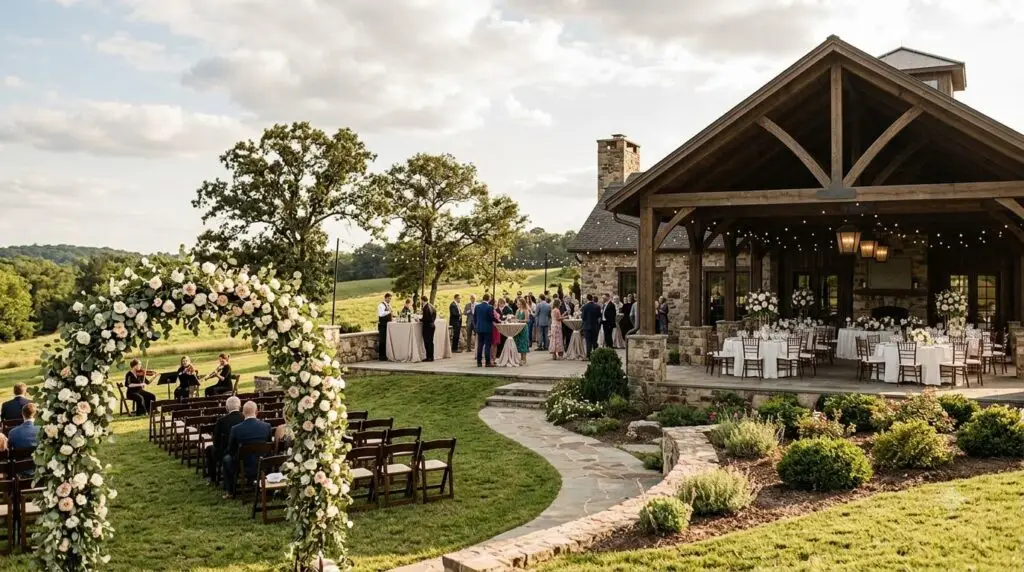
Hosting your wedding ceremony and reception at the same venue can remove one of the most complicated parts of a wedding day: moving an entire celebration from one location to another.
Guests arrive once. Vendors work from one property. Your photographer does not lose portrait time to another drive. And your wedding timeline does not depend on dozens or hundreds of people finding a second address.
But choosing one venue does not automatically make the day seamless.
A successful one-location wedding still requires careful planning around:
- Ceremony location
- Cocktail-hour space
- Reception layout
- Guest movement
- Room transitions
- Weather backup
- Photography
- Catering and bar service
- Vendor setup
- Accessibility
- Parking
- Timeline buffers
- Contract inclusions
The goal is to make one property feel like three different experiences rather than keeping guests in the same room doing the same thing all day.
Vista Ballroom in Hackettstown provides a useful example. Its current venue information describes wedding settings for ceremonies and receptions, outdoor lawn and patio access, on-site catering and beverage service, event-planning and timeline coordination, setup and breakdown, parking, accessibility, and a ballroom accommodating up to 200 seated guests.
This guide explains how to plan the entire flow from guest arrival through the final dance without creating unnecessary travel or awkward transitions.
What Does “Ceremony and Reception at the Same Venue” Actually Mean?
A same-venue wedding does not necessarily mean the ceremony and reception take place in the exact same room.
There are several possible setups.
Separate Spaces on One Property
For example:
Outdoor ceremony → patio cocktail hour → indoor ballroom reception
This usually creates the clearest separation between each part of the day.
Ceremony and Reception in the Same Room
The ceremony may take place in the ballroom, followed by cocktail hour elsewhere while staff transform the room for dinner and dancing.
This is often called a room flip.
Indoor and Outdoor Combination
Couples may use:
- Outdoor ceremony
- Indoor cocktail hour
- Ballroom reception
or another combination depending on the venue and weather.
When touring an all-in-one wedding venue in NJ, do not simply ask whether the venue can host the entire wedding.
Ask:
Where exactly will each phase happen, and how will guests move between them?
That answer reveals how the day will actually function.
Why Choose One Venue for the Entire Wedding?
The strongest benefit is not that everything happens under one roof.
It is that you remove an entire layer of wedding-day logistics.
Guests Do Not Need to Travel Between Events
This can be particularly useful for:
- Older relatives
- Guests with mobility needs
- Families with young children
- Out-of-town guests
- Anyone unfamiliar with the area
Guests arrive, park, and remain at the property until the celebration ends.
Your Timeline Has Fewer Transportation Variables
A separate ceremony and reception may require planning around:
- Traffic
- Parking at two locations
- Transportation schedules
- Guest departure timing
- Vendor travel
- Wedding-party transportation
Keeping events together removes many of those variables.
Vendors Can Work From One Main Location
Your photographer, videographer, DJ, florist, planner, caterer, baker, and other professionals have fewer location changes to coordinate.
This does not eliminate vendor planning, but it can simplify load-in, setup, communication, and timing.
More Wedding-Day Time Can Stay With the Celebration
If portraits, cocktail hour, and reception all happen on one property, time that would otherwise be spent traveling may be available for:
- Family photographs
- Couple portraits
- Cocktail hour
- Guest interaction
- A less rushed timeline
Start With a Three-Space Wedding Plan
Before building the timeline, identify the spaces used for the three major experiences.
| Wedding Phase | Main Purpose | Space Needs |
| Ceremony | Vows and formal beginning | Seating, aisle, sound, accessibility |
| Cocktail Hour | Transition and socializing | Drinks, food, standing/seating areas |
| Reception | Dinner and celebration | Tables, catering, dance floor, entertainment |
Each area should perform its own job well.
A visually impressive ceremony lawn does not automatically make a practical cocktail-hour space.
A large ballroom does not automatically provide enough room for 180 guests, a band, dance floor, photo booth, dessert display, and elaborate décor.
Plan each phase independently, then connect them.
Experience One: Planning the Wedding Ceremony
The ceremony is where guests form their first impression of the wedding day.
Choose the Ceremony Setting
Evaluate:
- Guest capacity
- Seating layout
- Aisle length and width
- Accessibility
- Sound
- Shade or sun exposure
- Photography angles
- Décor restrictions
- Proximity to restrooms
- Weather backup
Vista Ballroom’s current website describes wedding settings for ceremonies and receptions and promotes outdoor wedding use alongside its indoor ballroom. Its main venue information also confirms outdoor lawn and patio access.
If you are considering an outdoor ceremony, ask to see the exact ceremony location rather than relying only on general property photos.
Plan Guest Arrival Before Planning the Processional
Consider what happens from the moment a guest drives onto the property.
Ask:
- Where do guests park?
- How far is parking from the ceremony?
- Who directs guests?
- When should seating begin?
- Is there a separate entrance?
- Where are restrooms?
- Is water available if the weather is warm?
- Where should guests with mobility needs enter?
Vista Ballroom currently advertises ample parking and handicap accessibility.
For guests with specific accessibility needs, ask the venue to explain the exact route from parking to ceremony seating and then onward to cocktail hour and reception.
Confirm Ceremony Sound Requirements
Outdoor vows that cannot be heard by half the audience create a very beautiful silent film.
Ask whether your ceremony requires:
- Microphone
- Speakers
- Power
- Music playback
- Live-musician setup
Also confirm who provides and operates the equipment.
Do not assume the reception DJ automatically handles ceremony audio unless that service appears in your agreement.
Keep Ceremony Décor Connected to the Rest of the Wedding
You do not need to build three unrelated design concepts.
Use recurring elements such as:
- Color palette
- Floral style
- Signage
- Materials
- Typography
- Lighting
Then allow each area to express the theme differently.
Ceremony décor may focus on:
- Aisle
- Altar or arch
- Welcome sign
- Reserved seating
- Floral arrangements
If ceremony arrangements can be reused at the reception, discuss who is responsible for moving them and when.
Experience Two: Planning the Cocktail Hour
Cocktail hour has an important operational job.
It gives guests something enjoyable to do while:
- The couple takes photographs
- Formal family portraits are completed
- Reception details are finalized
- Staff complete any necessary room transition
It should feel intentional rather than like a hallway between two important events.
Choose a Cocktail-Hour Space With Enough Room
Plan for:
- Bar access
- Passed or stationary food
- Cocktail tables
- Limited seating
- Guest circulation
- Accessibility
- Music
- Restrooms
- Weather backup if outdoors
Vista Ballroom currently includes access to outdoor areas for cocktail hour or photography and lists outdoor lawn and patio use among its included venue services.
That makes the outdoor area relevant to the ceremony-to-reception transition, but exact space use should still be confirmed for the wedding date and guest count.
Decide How Much Seating You Need
Cocktail hour does not always require formal seating for every guest.
But adequate seating should be available for people who may need it, including:
- Older guests
- Pregnant guests
- Guests with disabilities
- Anyone unable to stand comfortably for an extended period
Ask the venue how seating is normally incorporated without blocking guest circulation.
Coordinate Cocktail-Hour Food With Dinner
Cocktail hour and reception dinner should feel like parts of the same menu, not two unrelated catering events.
Consider:
- Number of appetizers
- Dietary restrictions
- Dinner start time
- Meal size
- Bar service
- Whether food stations are included
Vista Ballroom currently provides on-site catering and beverage service, and its catering page lists wedding, cocktail-party, buffet, and sit-down dinner packages.
The specific wedding menu and cocktail-hour structure should be confirmed through the current package for your date.
Give Guests Something to Do Without Overprogramming the Hour
Options may include:
- Conversation
- Music
- Guest book
- Photo booth
- Lawn games
- Signature drinks
- Simple interactive displays
Vista Ballroom currently lists lawn games and photo-booth setup among optional enhancements.
You do not need five activities.
Cocktail hour already contains food, drinks, conversation, and people your guests may not have seen in years.
Experience Three: Planning the Wedding Reception
The reception has the most moving parts of the three phases.
The room may need to accommodate:
- Dining tables
- Head or sweetheart table
- Dance floor
- DJ or band
- Bar
- Cake
- Gifts/cards
- Dessert
- Photo booth
- Décor
- Catering service routes
Build the Reception Layout Around Your Actual Guest Count
Do not use maximum venue capacity as your floor plan.
Vista Ballroom currently publishes capacity for up to 200 seated guests or 300 guests for cocktail-style receptions.
Your comfortable reception capacity can be lower depending on:
- Dance-floor size
- Entertainment
- Table style
- Photo booth
- Food stations
- Décor installations
- Accessibility needs
Ask to see a floor plan based on your guest count and reception setup.
Choose the Dinner Style Before Finalizing the Layout
Different meal formats create different space and service requirements.
Options may include:
- Plated dinner
- Buffet
- Hybrid service
- Cocktail-style service
- Station elements where available
Vista Ballroom’s current public catering menu lists Dinner Buffet, Sit-Down Dinner, Elegant Sit-Down Dinner, wedding packages, and cocktail-party packages.
Confirm current package availability before designing the room around a particular service style.
Protect the Dance Floor From Layout Creep
It is easy for a dance floor to shrink as additional items are added.
Before approving the final floor plan, account for:
- DJ or band
- Dessert
- Photo booth
- Extra tables
- Lounge furniture
- Displays
- Décor
- Vendor equipment
If dancing matters to you, treat the dance floor as a planned space rather than whatever area remains.
How to Plan a Room Flip
A room flip happens when the same indoor space is used for both the ceremony and reception.
During cocktail hour, venue staff and vendors transform it.
This can work well, but you need answers before choosing it.
Ask:
- How long does the flip usually require?
- Where will guests go during it?
- Who moves ceremony furniture?
- Who moves floral arrangements?
- When are reception tables set?
- When is reception décor installed?
- What happens if the ceremony begins late?
- Can guests see the room being transformed?
- What is the backup if the flip takes longer than expected?
If your venue has separate ceremony and reception spaces, you may not need a major room flip at all.
That is one of the operational differences worth understanding during the tour.
Build a Realistic Same-Venue Wedding Timeline
Staying in one location does not mean every event should be scheduled back-to-back with no buffer.
A sample wedding day might look like this:
| Time | Activity |
| 3:15 PM | Guest arrival begins |
| 4:00 PM | Ceremony |
| 4:30 PM | Cocktail hour and portraits |
| 5:30 PM | Guests invited toward reception |
| 5:45 PM | Grand entrance |
| 6:00 PM | Dinner service |
| 7:15 PM | Toasts or formal dances |
| 7:45 PM | Open dancing |
| 9:00 PM | Cake/dessert |
| 10:45 PM | Final dance |
| 11:00 PM | Event concludes |
This is an example, not a required schedule.
Your actual timeline should account for:
- Ceremony length
- Photography
- Sunset
- Cocktail-hour duration
- Dinner service style
- Number of speeches
- Cultural traditions
- Entertainment
- Venue end time
Add Transition Buffers
Build a few minutes around major transitions.
Guests do not move from 150 ceremony chairs into a ballroom instantaneously.
Allow time for:
- Walking
- Restrooms
- Seating
- Mobility needs
- Staff instructions
- Vendor changes
A same-venue wedding removes driving time. It does not remove human beings.
Use the Property to Simplify Wedding Photography
One-location weddings can make photography more efficient because the photographer can plan several backgrounds without moving the wedding party to another venue.
Possible photo periods include:
- Before the ceremony
- Immediately after the ceremony
- During cocktail hour
- Sunset
- Brief evening portraits
Vista Ballroom currently advertises outdoor access for photography, rolling-green views, mountain backdrops, and ballroom interiors.
Create a Photography Location Plan
During the venue tour, identify:
- Couple portrait location
- Family-photo location
- Wedding-party location
- Indoor weather backup
- Sunset location
- Night portrait option
This reduces improvisation on the wedding day.
Decide Which Photos Must Happen During Cocktail Hour
Create a priority list.
For example:
- Immediate family
- Wedding party
- Couple portraits
- Extended family if time allows
The fewer combinations you improvise on the day, the more cocktail hour the couple may actually get to experience.
Coordinate Vendors Around One Master Schedule
One location simplifies vendor travel, but vendors still need precise instructions.
Create one shared timeline covering:
- Vendor arrival
- Load-in
- Ceremony setup
- Sound check
- Floral delivery
- Photography start
- Catering service
- Reception entrance
- Toasts
- Cake
- Entertainment
- Breakdown
Confirm Vendor Policies With the Venue
Ask about:
- Approved or preferred vendors
- Outside-vendor restrictions
- Insurance requirements
- Load-in time
- Loading location
- Power availability
- Décor restrictions
- Open-flame rules
- Sound restrictions
- Breakdown deadline
Your florist knowing the building address is not the same as your florist knowing where and when they are allowed to unload 14 centerpieces.
Create a Weather Plan Before You Need One
If the ceremony or cocktail hour is outdoors, weather backup is part of the wedding plan, not an optional emergency conversation.
Ask:
- What exact indoor area replaces the ceremony?
- Does it comfortably hold the full guest count?
- Where does cocktail hour move?
- Who decides when to activate the backup plan?
- At what time is the decision made?
- Who informs vendors?
- Does the floor plan change?
- Are there additional charges?
Vista Ballroom markets outdoor wedding use alongside its indoor ballroom, but the exact rain-plan configuration for a particular wedding should be confirmed directly with the venue.
Do not settle for “don’t worry, we have an indoor option.”
Ask to see it.
Plan for Accessibility Across the Entire Guest Journey
Accessibility should cover more than the ballroom entrance.
Walk through:
Parking → ceremony → cocktail hour → reception → restrooms → departure
Consider:
- Step-free access
- Distance between spaces
- Accessible parking
- Seating
- Restrooms
- Outdoor surfaces
- Lighting
- Guests using wheelchairs or walkers
Vista Ballroom currently advertises handicap accessibility and ample parking.
If someone important to you has specific mobility needs, evaluate their actual route rather than relying solely on an accessibility label.
Does One Venue Save Money?
Sometimes, but not automatically.
A one-location wedding may reduce or eliminate certain expenses such as:
- Guest shuttles between ceremony and reception
- Additional wedding-party transportation
- Duplicate delivery trips
- Separate venue rentals
But you may still pay separately for:
- Ceremony space
- Additional event hours
- Setup
- Décor
- Catering
- Bar
- Rentals
- Overtime
- Security
- Insurance
- Specialty equipment
The useful comparison is not:
One venue vs two venue rental prices
It is:
Total cost of the complete wedding-day plan in each scenario
Ask for an Itemized Proposal
Confirm whether pricing includes:
- Ceremony space
- Cocktail-hour space
- Reception space
- Tables
- Chairs
- Linens
- Setup
- Breakdown
- Catering
- Bar
- Staffing
- Service charges
- Taxes
- Overtime
- Outdoor-space use
- Weather backup
Vista Ballroom currently lists event planning and timeline coordination, catering and beverage service, tables, chairs, linens, glassware, flatware, setup and breakdown, and lawn/patio use among its included services.
Your specific wedding proposal should determine which services and prices apply to your date and package.
How to Make Three Experiences Feel Different at One Venue
Guests do not need three addresses to feel like the wedding evolved throughout the day.
Use changes in:
- Space
- Lighting
- Music
- Food
- Seating
- Décor intensity
- Energy
Ceremony
Keep the focus on vows and emotion.
Possible elements:
- Soft music
- Simple floral framing
- Formal seating
- Calm color palette
Cocktail Hour
Increase movement and conversation.
Use:
- Passed food
- Drinks
- Cocktail tables
- Lighter music
- Outdoor access where appropriate
Reception
Shift toward celebration.
Use:
- Stronger lighting
- Dinner
- Formal introductions
- Dance floor
- Entertainment
- Dessert
The goal is progression, not three completely unrelated themes.
Questions to Ask Before Booking an All-in-One Wedding Venue
Ceremony
- Where exactly can the ceremony take place?
- What is the maximum and comfortable ceremony capacity?
- What is the indoor weather backup?
- Are ceremony chairs included?
- Who sets up and breaks down the ceremony?
- What sound equipment is required?
- Is the ceremony space accessible?
Cocktail Hour
- Where will cocktail hour happen?
- Is indoor and outdoor space available?
- How much seating is provided?
- How are appetizers and bar service structured?
- Where do guests go if weather changes?
Reception
- What is the seated reception capacity?
- How does our guest count affect dance-floor size?
- Which meal-service formats are available?
- What tables, chairs, and linens are included?
- What entertainment and décor restrictions apply?
Logistics
- How do guests move between each space?
- Is parking on-site?
- Where do vendors load in?
- What time can vendors arrive?
- Is setup and breakdown included?
- Are outside vendors allowed?
- Are insurance or security requirements involved?
- What is the event end time?
- What are the overtime charges?
- What are the cancellation and rescheduling terms?
- When is the final guest count due?
Planning
- Who is our main venue contact?
- Who manages the wedding-day timeline?
- Can we review a complete floor plan before finalizing?
- When is the final planning meeting?
If the ceremony, cocktail hour, and reception are the backbone of the entire wedding day, the contract should make the logistics of all three clear.
Planning a Ceremony, Cocktail Hour and Reception at Vista Ballroom
Vista Ballroom is located at 1 Forest Drive in Hackettstown, NJ and currently markets the property for wedding ceremonies and receptions.
Current published venue features include:
- Capacity for up to 200 seated guests
- Up to 300 guests for cocktail-style receptions
- On-site catering and bar packages
- Outdoor access for cocktail hour or photography
- Private lobby and coat check
- Handicap accessibility
- Ample parking
- Event-planning and timeline coordination
- Tables, chairs, linens, glassware, and flatware
- Event setup and breakdown
- Outdoor lawn and patio use
Vista’s current wedding-related content also describes outdoor ceremony use followed by an indoor ballroom reception.
For couples considering the venue for the full wedding day, the next step should be confirming the exact setup rather than assuming every wedding uses the same spaces.
Ask Vista specifically:
- Which ceremony area is available for our date?
- Where would our cocktail hour happen?
- What would our ballroom floor plan look like?
- What is the weather backup?
- Is any room flip required?
- What is included in our wedding package?
- Which catering format fits our guest count?
- What are the event hours?
- What vendor rules apply?
Vista currently lists (908) 441-6757 and reservations@vistaballroom.com as contact information.
Same-Venue Wedding Planning Checklist
Before Booking
- Ceremony space identified
- Cocktail-hour space identified
- Reception space identified
- Guest capacity confirmed for each
- Weather backup inspected
- Parking reviewed
- Accessibility route reviewed
- Itemized proposal received
- Contract restrictions reviewed
Ceremony
- Seating plan created
- Sound plan confirmed
- Décor plan finalized
- Guest-arrival plan created
- Weather decision process confirmed
Cocktail Hour
- Location finalized
- Food selected
- Bar service confirmed
- Seating/accessibility considered
- Entertainment selected if needed
Reception
- Floor plan approved
- Dinner service selected
- Dance floor confirmed
- DJ/band placement confirmed
- Cake/dessert location confirmed
- Dietary meals arranged
Vendors and Timeline
- Master timeline created
- Load-in instructions distributed
- Photography locations selected
- Room-flip responsibilities confirmed if applicable
- Vendor contact list shared
- Breakdown schedule confirmed
Frequently Asked Questions
Is it better to have the wedding ceremony and reception at the same venue?
It can be particularly convenient when you want to reduce travel, simplify guest movement, and keep vendors working from one property. The best choice still depends on the venue’s ceremony, cocktail-hour, reception, weather-backup, and accessibility setup.
Does the ceremony have to be in the same room as the reception?
No. Many same-venue weddings use different areas on the same property, such as an outdoor ceremony, patio cocktail hour, and indoor reception.
What happens between the ceremony and reception?
Cocktail hour typically provides the transition. Guests enjoy food, drinks, and conversation while portraits are taken and any final reception setup or room flip is completed.
What is a wedding room flip?
A room flip is when one event space is transformed from ceremony seating into the reception setup while guests are elsewhere, often during cocktail hour.
How long should we allow between the ceremony and reception?
There is no universal number. Allow enough time for guest movement, photography, cocktail service, and any room transition. Your photographer, venue, and caterer should build the timing around your actual wedding plan.
Is having the ceremony and reception at one venue always cheaper?
No. It may reduce transportation or duplicate venue costs, but ceremony fees, additional hours, rentals, catering, service charges, and other package costs can offset those savings. Compare complete proposals.
What happens if an outdoor ceremony is rained out?
A venue should have a clearly defined indoor alternative. Ask to see the backup space, confirm its capacity, and understand when and how the weather decision is made.
Can Vista Ballroom host both wedding ceremonies and receptions?
Vista Ballroom’s current website promotes the property for ceremonies and receptions and its wedding content describes outdoor ceremony use with an indoor ballroom reception. The exact ceremony location and package should be confirmed for your date.
How many wedding guests can Vista Ballroom accommodate?
Vista Ballroom currently publishes capacity for up to 200 seated guests or 300 guests for cocktail-style receptions. Actual comfortable capacity will depend on your floor plan, dining setup, dance floor, entertainment, and décor.
Does Vista Ballroom provide catering?
Yes. The venue currently advertises on-site catering and beverage service, while its catering page lists wedding packages, cocktail-party packages, dinner buffets, and sit-down dinners.
Does Vista Ballroom have parking and accessible facilities?
Vista Ballroom currently advertises ample parking and handicap accessibility.
Final Takeaway
Hosting your wedding ceremony and reception at the same venue can make the day easier, but convenience alone should not determine the decision.
A strong all-in-one venue needs to support the entire guest journey:
Arrival → ceremony → cocktail hour → reception → departure
Before booking, understand exactly where each phase happens, how guests move between spaces, what happens if the weather changes, how vendors load in, how the reception layout works, and what your contract actually includes.
Then give each phase its own purpose.
Let the ceremony feel focused and emotional.
Let cocktail hour create movement and conversation.
Let the reception shift into dinner, dancing, and celebration.
That is how one location becomes three distinct experiences without adding three sets of logistics.
For couples considering Vista Ballroom in Hackettstown, the venue currently provides indoor and outdoor wedding-related spaces along with catering, beverage service, planning coordination, setup and breakdown, parking, accessibility, and outdoor lawn/patio access.
Before booking, bring your estimated guest count, ceremony preference, reception layout, weather concerns, catering needs, and entertainment plans to the venue tour so the team can show you exactly how your complete wedding day would flow.